Why Don't They Just Leave? The Problem With Haunted Houses
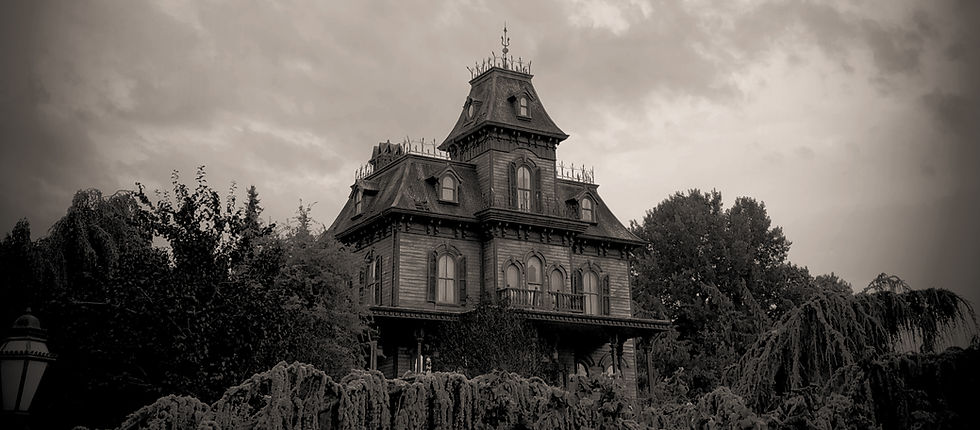
There's a point in almost every haunted house story where someone makes a decision that has me questioning their survival instincts.
The walls are bleeding. There's something standing at the end of the hallway. A door has opened into a room that definitely wasn't there yesterday.
And the characters are still discussing whether they should stay.
I have absolutely yelled at characters to get out of the house. Sometimes there's a perfectly good reason they can't leave. Other times, I have to wonder whether the ghost is even the biggest threat to their survival.
But I love a good haunted house story, especially when the house itself is the thing doing the haunting. Give me a building that doesn't follow the rules of reality, a room that changes when nobody's looking, or a hallway that should be three feet long but somehow stretches into darkness.
I want to know what's happening. I want to understand why.
Which, now that I think about it, is probably how I'd get killed in one of these stories.
Haunted Houses Don't Start With Murder
My favorite kind of haunted house story takes its time.
It starts with something small. Maybe a door opens when nobody is near it. An object moves. A mirror fogs over when it shouldn't. Something happens that makes the character pause, look around, and decide there must be a reasonable explanation.
And sometimes there is!
I once spent about two weeks thinking something was moving an object on my dresser. It kept shifting position, and I couldn't figure out why. Eventually, I discovered that opening one of my drawers was moving the fabric underneath it just enough to throw it off balance.
Not particularly supernatural, unless the ghost was responsible for my furniture arrangement.
But that's why those early moments work so well in horror. People want the world to make sense. We have explanations for drafts, strange noises, faulty wiring, and things that go missing. Most of us will consider those possibilities before deciding our home is haunted.
A good story uses that instinct.
One incident becomes two. Then three. By the time the character realizes something is wrong, they can look back and see dozens of things they dismissed.
I find that gradual dread much more effective than a house announcing its intentions by throwing someone down the stairs on the first night.
Of course, once it starts actively trying to kill people, I do think it's time to consider other housing arrangements.
Leaving Isn't Always That Simple
There are plenty of practical reasons someone might stay in a haunted house.
Maybe their car won't start. Maybe the doors won't open. Maybe they can't afford to move, or they've inherited a property they can't easily abandon. Maybe they've entered the house to find someone they love, and leaving means abandoning that person.
Some of these reasons come up more often in fiction than others. Money and housing insecurity, for example, seem like obvious obstacles, but I don't encounter them as often as I'd expect in haunted house stories.
Then there are the psychological reasons.
Curiosity is a powerful one. So are pride, grief, guilt, love, and plain old stubbornness.
One of my favorite books is House of Leaves by Mark Z. Danielewski. My copy is covered in notes and markings. Yes, I write in my books. They're meant to be enjoyed, and annotating them is part of how I enjoy reading.
Anyway, House of Leaves does something I find fascinating. The house contains spaces that shouldn't exist. Its interior measurements don't match its exterior, and its impossible architecture becomes an obsession for the people trying to understand it.
Navidson, in particular, makes decisions that I can only describe as spectacularly stupid.
I love him for it.
He has an opportunity to investigate something that challenges his understanding of reality, and he cannot leave it alone. His obsession makes sense to me, even when his choices are terrible.
That's what I want from a haunted house story. I don't need characters to make good decisions. I need to understand why they're making them.
It's a principle I use when writing and running tabletop roleplaying games, too. Knowing that a character would or wouldn't do something is only the first step. You need to understand the emotional and practical reasons behind that choice.
"Because they wouldn't leave" tells me almost nothing.
Why wouldn't they?
What are they afraid of losing? What do they hope to gain? What do they believe will happen if they walk away?
Those answers matter more to me than whether the character makes the sensible choice.
And sometimes the house encourages them to believe they're making that choice freely.
There's Something Worse Than a Locked Door
A character who tries to escape and discovers the doors won't open is in immediate danger. They know something is wrong. They know they're trapped.
I find it more disturbing when they could walk through the front door, but can't bring themselves to do it.
A haunted house can become an obsession. It can offer someone answers, comfort, love, or a sense of purpose. It can convince them that staying is necessary, even when everything around them suggests otherwise.
People can become attached to places that hurt them. They can convince themselves that things aren't as bad as they seem, especially when acknowledging the truth would mean questioning something important about their lives.
And what happens when the house itself starts interfering with that judgment?
In House of Leaves, the building violates the rules of physical space. In my novel, The Colors That Haunt Us, Rosenfeld Manor slowly interferes with Clara's memories.
There are countless ways to approach this idea. A house might change its layout, distort time, alter memories, or make its occupants question what they've seen. It might even convince someone that the danger outside its walls is greater than anything waiting within them.
The illusion of choice is one of my favorite things to explore in horror.
A locked door is frightening. Someone standing in front of an open door, convinced they have no reason to walk through it, can be worse.
When Your Home Turns Against You
I think haunted houses work because homes are supposed to be safe.
We spend so much time shaping our living spaces around ourselves. We choose furniture, decorate walls, arrange our belongings, and create routines. We decide how a room should look, feel, and smell. These little choices make a space familiar.
A haunting interferes with that familiarity.
Something moves where you didn't put it. A room feels different. You hear a noise from somewhere that should be empty. The place you know better than anywhere else becomes something you can no longer trust.
There's a particular cruelty in that.
A haunted house can also be frightening in almost any location. Put it in the middle of nowhere, and the characters have to deal with the knowledge that nobody will hear them scream.
Put it in a busy neighborhood, and you have a different problem. People might hear. They might see what's happening. They might decide it isn't their business.
I don't know which possibility bothers me more.
Then there's the question of what the house wants.
Sometimes the haunting is personal. Something has happened, someone is angry, and the characters are being punished for reasons they may or may not understand.
Other times, the horror comes from something closer to cosmic indifference. The house doesn't hate you. It doesn't particularly care that you exist. You're simply inside something vast and incomprehensible, and your survival means nothing to it.
I enjoy both approaches.
I also love when a story establishes rules for its haunting and then breaks them. A character might learn that the ghost only appears after midnight, or that certain rooms are safe. Once they've begun trusting those rules, changing them can be terrifying.
As a writer, I want to understand how the haunting works, even if the characters never do.
As a reader, I'm perfectly happy to encounter something I cannot explain.
Rosenfeld Manor and the Choice to Stay
When I started writing The Colors That Haunt Us, I knew I wanted an abandoned manor that might not exist.
I also knew obsession would be central to the story.
Clara arrives at Rosenfeld Manor with her own reasons for wanting to get away from her life. Over time, the manor offers her something she desperately wants: a place where she feels seen and wanted.
Suzette is a large part of that.
I wanted Clara to struggle with the difference between love and obsession. I wanted her to need connection while becoming increasingly separated from the people who already cared about her.
That separation matters because Clara has friends who care. Their concern doesn't simply disappear. Her ability to recognize it changes.
Rosenfeld Manor is also closely tied to Suzette's history. The house emerges from her desire to be loved in a world that wouldn't allow her to be herself. It carries that longing, along with an overwhelming desire for someone to stay.
The manor was always meant to reflect depression, isolation, obsession, and the experience of being trapped in an identity other people have chosen for you.
I've often used haunted houses to explore the feeling of being trapped in your own body, whether through trauma, gender, or the loss of a place where you once felt safe.
A house can become an extension of its occupant. When it begins rejecting the person living inside it, that rejection can feel deeply personal.
There are plenty of things Clara could and should have done differently.
I wanted that to be part of the horror.
She has chances to make other decisions, but how much freedom does she have when her memories, desires, and sense of belonging have all become tangled up with the manor?
How do you know when you're making a choice if something has been quietly changing the way you see the world?
I won't answer that question for Clara here. I'd rather readers come to their own conclusions.
Sometimes, They Should Absolutely Leave
For all my love of haunted houses, I don't think every story earns its characters' decision to stay.
Sometimes the reasoning is thin. Sometimes a writer invents so many obstacles that the house starts to feel like it has plot armor. Every escape route fails at exactly the right moment, and every attempt to get help produces another convenient disaster.
That approach can work, but it needs care.
A character can make an awful decision and still be believable. People do that every day. The important part is giving the decision a foundation.
A person who stays because they're grieving will behave differently from someone who stays because they're curious. Someone trying to save a loved one has different priorities from someone determined to prove the supernatural exists.
And a person who stays because they don't believe they're in danger needs a different kind of story from someone who knows exactly what the house is doing.
The reader needs to understand what brought the character there in the first place. That's the question I consider most important.
Once I understand that, I'm willing to follow them through quite a lot of terrible decisions.
Though I reserve the right to yell at them while they make those decisions.
So, Would I Leave?
Here's where I have to admit something.
I've experienced things in my own home that I couldn't explain. Objects have moved. Devices have beeped or turned on when I didn't expect them to. I've had experiences that made me wonder whether something was sharing the space with me.
And I didn't leave.
I investigated. I have pendulums and other items I use when trying to communicate with spirits. My general approach is to make it clear that I'm happy to coexist peacefully as long as whatever might be there feels the same way.
I also believe in treating a possible presence with respect, which is a whole separate conversation about ghost hunters and their apparent commitment to antagonizing everything they encounter.
The point is that I've never felt threatened by anything I've experienced at home.
If something began acting with the clear intention of hurting me, I'd reconsider my living arrangements. Until then, I'm not particularly concerned about sharing a space with something I don't understand.
Which probably explains quite a lot about my taste in horror.
I'm willing to admit that my curiosity might get me into trouble in a fictional haunted house. I might investigate the strange room. I'd probably want to know why the hallway was longer than it should be.
I might even stay longer than was sensible.
So perhaps I shouldn't judge those fictional characters quite so harshly.
Though if the walls start bleeding, I'm still going to recommend leaving.
What about you? What's the smallest thing a house could do that would make you pack your bags?


Comments